

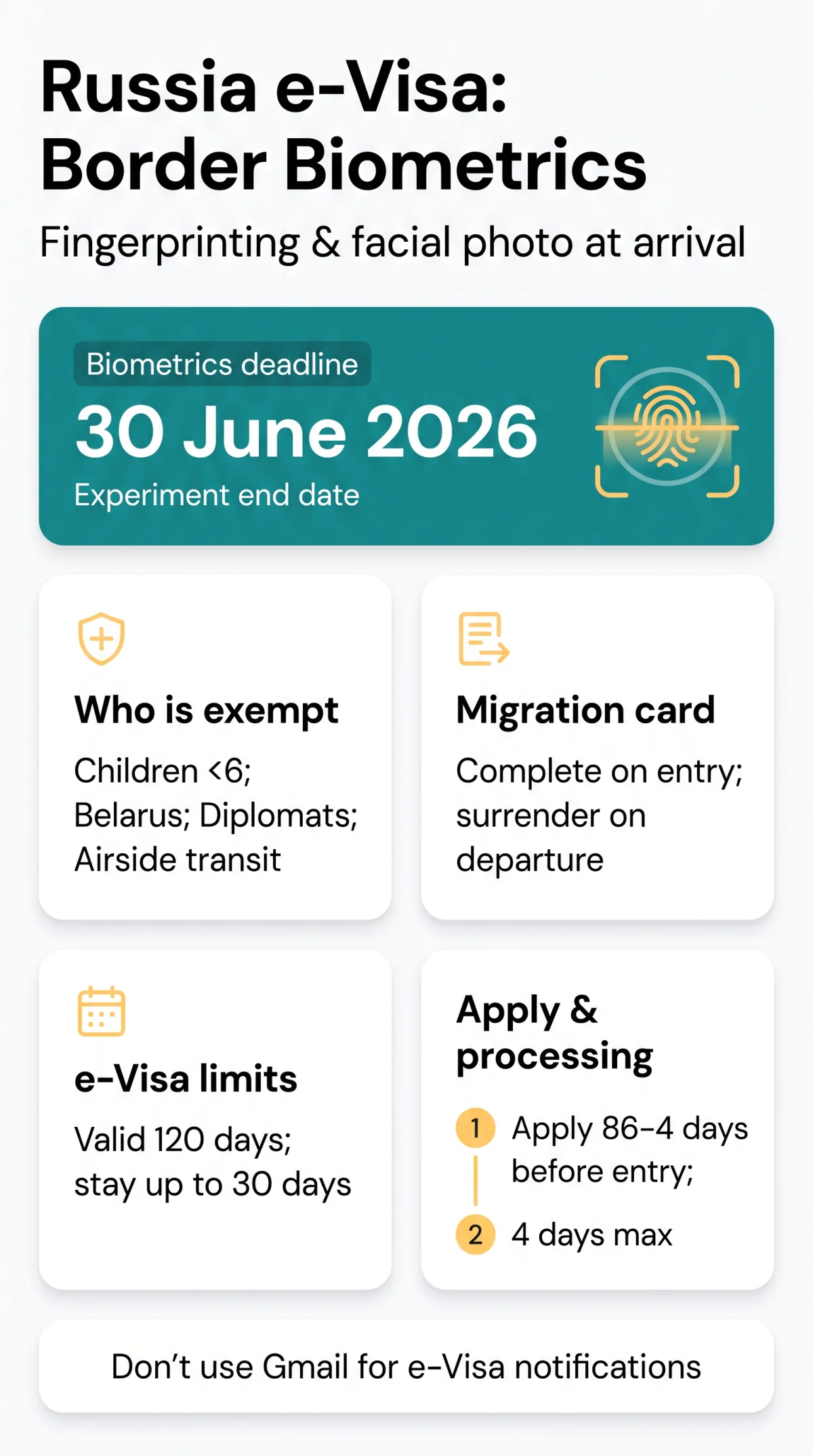
The Russia e-Visa biometrics rule requires all adult foreign nationals to provide fingerprints and a facial photo at border control under a government experiment running from 1 December 2024 to 30 June 2026. Travellers must also complete a migration card upon entry and surrender it on departure. The experiment (Decision No. 1510, enacted 7 November 2024) expanded to all Russian border crossings on 30 June 2025. Data links fingerprints and facial images via the Unified Biometric System (UBS). Exemptions: children under 6, Belarusian citizens, diplomatic passport holders, international organisation officials, and airside transit passengers.
Published: 15 September 2026 | Last reviewed: 15 September 2026 | By the Editorial Team, covering Russian visa policy since 2017. External sources: official MFA e-Visa portal and FCDO travel advisories.
UK nationals are ineligible for the e-Visa and must obtain a regular visa, providing biometrics at a consulate in the UK. The e-Visa is available to 64 nationalities, valid for 120 days from issue, with applications accepted 86 days earliest and 4 days latest before entry. Processing takes maximum 4 calendar days. Do not use Gmail for notifications; use Outlook, ProtonMail, or Yahoo, as the official MFA portal warns of unstable delivery. All e-Visa holders must carry valid medical insurance for stays of up to 30 days.
Russia e-Visa Biometrics Rule: Fingerprinting on Arrival
The Russia e-Visa biometrics rule mandates fingerprinting and facial photo capture at border control for all adult foreign nationals under a government experiment running until 30 June 2026.
- 1 December 2024 – Phase 1 at Mashtakovo land border (Orenburg region) and Zhukovsky Airport (Moscow) under Decision No. 1510, signed 1 November 2024 and enacted 7 November 2024.
- 30 June 2025 – Phase 2 expanded collection to all border crossings of the Russian Federation.
- Officers capture fingerprints and a digital facial photo, storing both in the Unified Biometric System (UBS) linked to a central digital profile.
- Travellers present passport and e-Visa confirmation; the officer scans four fingers per hand plus both thumbs separately, then takes a facial image.
The Russia e-Visa biometrics rule applies to all foreign nationals and stateless persons entering Russian territory, regardless of nationality. There are 29 approved checkpoints, including St Petersburg Pulkovo Airport and the Passenger Port of St Petersburg.
Traveller tip: At Sheremetyevo in June 2025, the entire fingerprinting process took under 40 seconds. Modern crossings print the migration card automatically after your passport is scanned.
Who Is Exempt from Fingerprinting?
Under the Russia e-Visa biometrics rule, the following are exempt from border biometrics:
- Children under the age of 6 (border experiment)
- Citizens of Belarus
- Diplomatic passport holders and officials of recognised international organisations, including their families
- Airside transit passengers who do not clear passport control
Note: The under-12 exemption applies only to consular visa applications, not to border biometrics.
What Happens If You Refuse Fingerprinting?
Entry denied
Under Decree No. 1510, paragraph 1, points 5-6
Return to origin
The traveller is returned to their country of origin
Entry-denial stamp
Passport stamped; possible re-entry restrictions may apply
No publicly documented exemption protocol exists for temporary hand injuries. Officers will scan available fingers; if too many are unreadable, secondary screening may follow. Remove bandages if safe, or carry a medical certificate.
Biometric Requirements by Entry Type: E-Visa vs. Regular Visa vs. Visa-Free
Under the Russia e-Visa biometrics rule, e-visa holders provide biometrics at the border, regular-visa holders at the consulate, and visa-free travellers pre-register via the RuID app. UK nationals use the regular visa track.
| Requirement | E-Visa | Regular Visa | Visa-Free |
|---|---|---|---|
| When biometrics collected | At border control upon arrival | During visa application at consulate | Pre-registered via RuID app at least 72 hours before arrival |
| Where | Border crossing point | Consulate / visa centre | Gosuslugi RuID app |
| Data collected | Fingerprints + facial photo | Fingerprints + facial photo | Fingerprints + facial photo |
| Exemptions | Children under 6; Belarusian citizens; diplomats | Children under 12 | Children under 6; Belarusian citizens |
| RuID app required | No (digital profile created automatically) | No | Yes |
| UK nationals | Ineligible | Must use this track | N/A |
| Penalty for non-compliance | Denied entry | Visa refusal | Denied entry |
The Russia e-Visa biometrics rule does not change visa fees, processing times, or requirements. Biometric collection is free of charge.
How to Fill Out the Russian Migration Card Step by Step
Every foreign national receives a two-part migration card at border control that must be completed accurately and surrendered on departure. The Russia e-Visa biometrics rule ties the card to your permitted stay of up to 30 days.
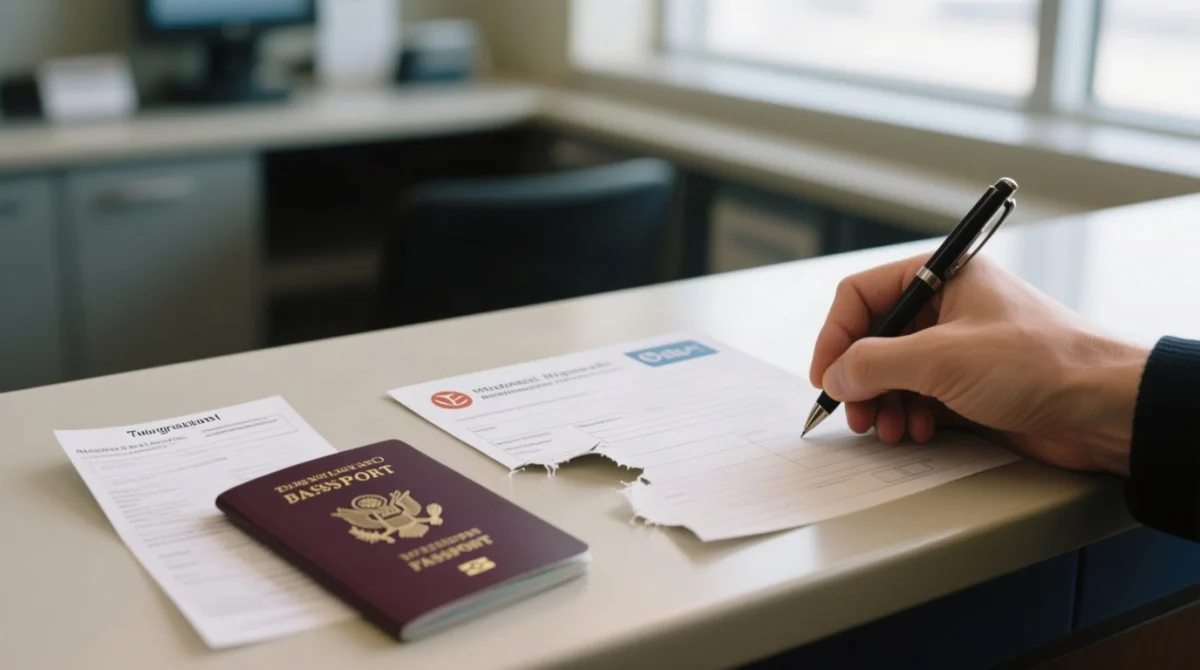
The card has Russian and English headings. Modern crossings print it automatically; older posts distribute blank forms. Validity matches your e-Visa stay: up to 30 days. Both arrival and departure days count as two full days.
Surname and name
Enter exactly as printed in your passport.
Patronymic
Write “N/A” if your passport does not contain one.
Date of birth, gender, citizenship
Self-explanatory fields.
Passport number
Copy from the machine-readable page.
Visa number
Enter your e-Visa reference if requested.
Purpose of visit and duration of stay
Match your e-Visa category; state the number of days, not exceeding 30.
Registration address
Leave blank if unknown; your hotel completes this during migration registration within 72 hours of arrival.
Retain the detachable Talon B throughout your stay, present it at hotel registration, and surrender it at departure. If lost or damaged, request a replacement from the nearest migration office (OVM) with your passport and hotel registration.
Biometric Data Privacy and Retention Under Russia’s E-Visa System
Biometric data collected under the Russia e-Visa biometrics rule is stored in the Unified Biometric System (UBS) with no publicly defined fixed retention period. The UBS digital profile contains fingerprints, facial photo, employment information, and travel purpose. Access is limited to authorised agencies including the FSB, MVD, and border services. For comparison, the EU Schengen VIS retains biometric data for 5 years. Travellers should assume data may be stored indefinitely unless stated otherwise. UK travellers should review current FCDO travel advisories before travelling.
The Gosuslugi RuID app, required for visa-free pre-registration, was unavailable at Phase 2 launch in June 2025. Visa-free travellers must submit electronic entry requests at least 72 hours before arrival (or 4 hours for urgent medical care). The Russia e-Visa biometrics rule does not apply to those who remain airside.
FAQ: Russia e-Visa Biometrics Rule and Migration Card
Do I need to provide fingerprints when entering Russia with an e-Visa?
Yes. All adult foreign nationals must provide fingerprints and a facial photo at border control under Decision No. 1510.
How do I fill out the Russian migration card as a UK tourist?
Enter your surname, name, date of birth, nationality, passport number, purpose of visit, and duration of stay. Leave “Patronymic” blank or write “N/A”.
Who is exempt from fingerprinting at Russian border control?
Children under 6, Belarusian citizens, diplomatic passport holders, international organisation officials and their families, and airside transit passengers.
What happens if I refuse to give my fingerprints at the Russian border?
Refusal results in denied entry, return to your country of origin, and a possible re-entry restriction under Decree No. 1510, paragraph 1, points 5-6.
How long is the Russian migration card valid?
The card is valid for your full authorised stay of up to 30 days. Both arrival and departure days count as two full days.
Do I need to register my address in Russia after arrival?
Yes. E-Visa holders must register their address within 72 hours of arrival. Hotels typically handle this automatically.
What should I do if I lose my migration card in Russia?
Report the loss to the nearest police or migration office (OVM) with your passport and hotel registration to receive a replacement.
Is my biometric data safe when entering Russia?
Data is stored in the Unified Biometric System (UBS) with no publicly defined retention period. Schengen VIS retains data for 5 years. Check current FCDO advisories.
Do transit passengers need to provide biometrics in Russia?
No. Transit passengers who remain airside without clearing passport control are exempt from biometrics and migration card issuance.
What does the fingerprinting process look like at Russian airports?
Six flat-finger scans (4 right, 4 left, 2 thumbs) plus a facial photo at a biometric kiosk. The entire process takes under a minute.