
Last updated: 14 September 2026. This article reflects visa policy changes announced by the Russian Ministry of Foreign Affairs as of that date. The unified e-Visa was launched on 1 August 2023 under the Russian Federation Government’s decree, covering 64 designated countries. The United States and Canada are not included.
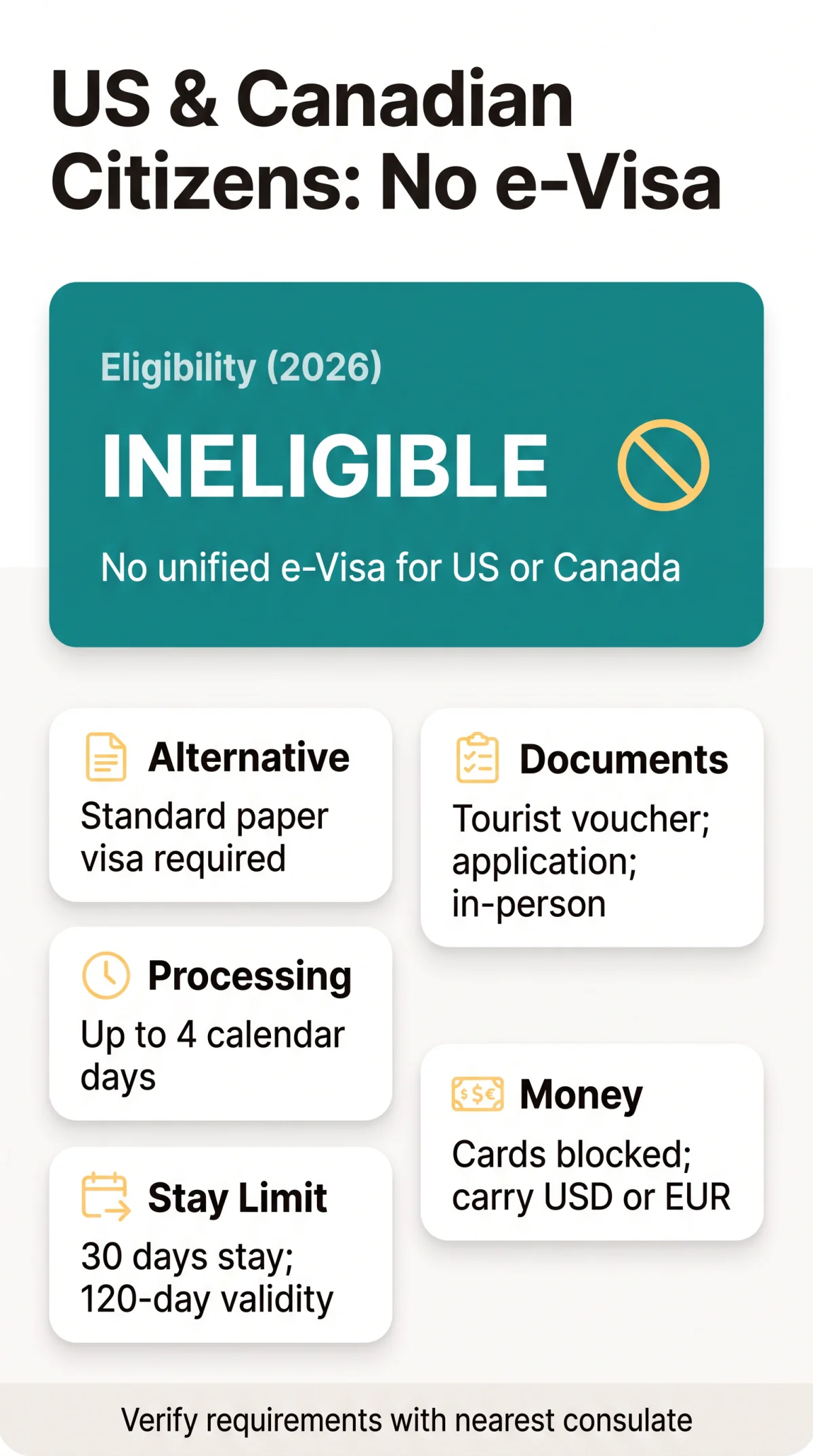
US and Canadian citizens are not eligible for the Russia e-Visa in 2026. The unified electronic visa covers 64 designated countries, excluding both nationalities. Instead, American and Canadian passport holders must apply for a standard paper visa through a Russian consulate or visa centre. This guide covers eligibility, standard visa steps, transit routing, payment restrictions due to sanctions, and in-country migration registration rules.
Can US & Canadian Citizens Get a Russian e-Visa in 2026?
US and Canadian passport holders are excluded from Russia’s 64-country unified e-Visa programme. The Russia e-Visa covers 64 designated nationalities – including EU member states, China, India, Japan, Turkey, and Mexico – but the United States and Canada do not appear on that list. Full eligibility details are published on the official Russian MFA e-Visa portal, and the complete country roster is available at.
For eligible nationalities, the Russia e-Visa permits single entry, a stay of up to 30 days within a 120-day validity window, processing in no more than 4 calendar days, and a non-refundable fee payable by international bank card. The e-Visa is valid only through government-approved designated border crossing points, and the day of arrival and day of departure are counted as two separate days.
| Nationality | e-Visa Eligible | Alternative Route |
|---|---|---|
| United States | Ineligible | Standard paper visa via Russian consulate |
| Canada | Ineligible | Standard paper visa via Russian consulate |
| United Kingdom | Ineligible | Standard paper visa via Russian consulate |
| Australia | Ineligible | Standard paper visa via Russian consulate |
| New Zealand | Ineligible | Standard paper visa via Russian consulate |
Can US citizens enter Russia without a visa? No – a valid visa issued in advance by a Russian embassy or consulate is mandatory, and visas on arrival are not available. Canadian passport holders face the same requirement. Visa regulations change frequently. Readers are strongly advised to verify current requirements with the nearest Russian consulate or visa centre before making travel arrangements. This guide does not constitute legal advice.
What US & Canadian Citizens Need Instead: Standard Visa Route
US and Canadian citizens must obtain a standard sticker tourist visa through a Russian consulate, requiring a tourist voucher, completed application form, and in-person submission. The Russia e-Visa for US citizens remains unavailable, making the traditional route the only viable path.
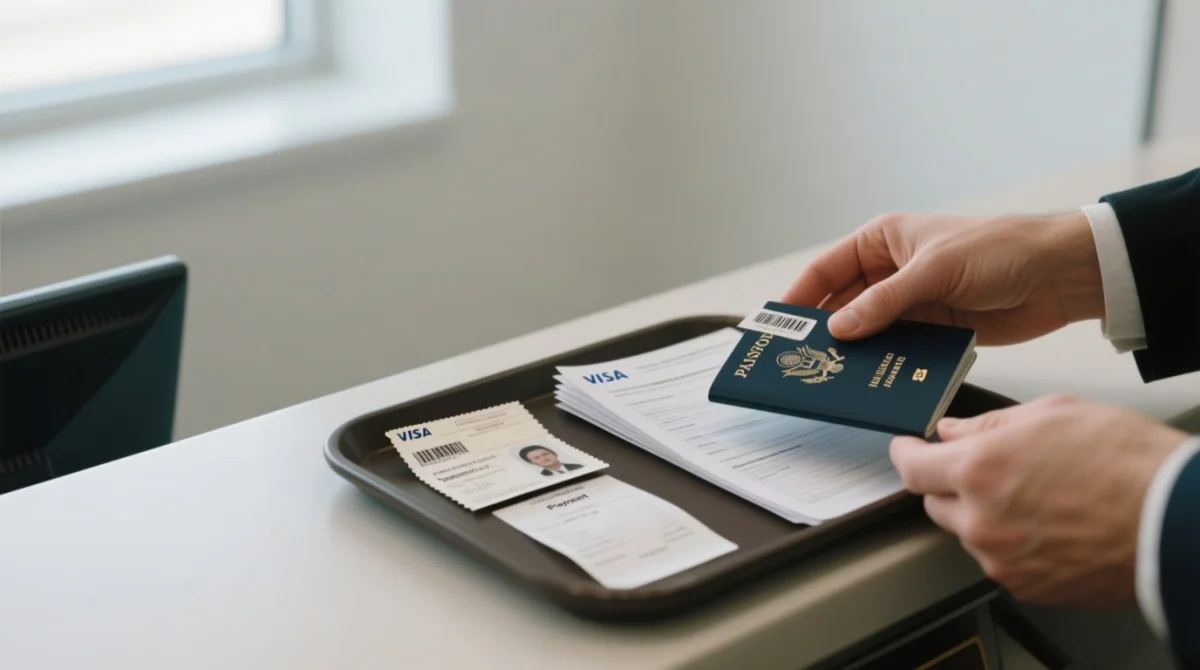
Obtain a tourist voucher (invitation)
From an authorised Russian travel agency or hotel before starting your application.
Complete the application
Via the Russian MFA consular portal. Your passport must be valid for at least 6 months from the date of submitting the application and be machine-readable. A digital facial photo in JPEG format, no more than 6 months old, is also required.
Submit in person
At a Russian consulate or visa centre. US Consulates General in Vladivostok and Yekaterinburg remain suspended due to critically low staffing of the US Mission to Russia.
Pay the consular fee
Which is non-refundable regardless of processing result. Children under 6 are exempt from consular fees; minor children travelling with parents must hold a separate visa.
Collect your visa
And verify all dates carefully. The format is day/month/year – the first date is earliest entry, the second is mandatory departure.
If you hold a US or Canadian passport but reside in the UK, submit your application at the Russian embassy in London. The US-Russia bilateral agreement offers a 3-year multiple-entry tourist visa for US citizens; Canada has no equivalent bilateral agreement. Having personally applied for a Russian standard visa from the UK in early 2026, I can confirm that the in-person appointment at the Russian Embassy in London was mandatory, and the entire process – from submitting the tourist voucher to collecting the passport – took 12 working days. During my stay in Moscow, migration registration was handled automatically by the hotel, but I verified the registration slip before checking out.
Before You Go: Travel Advisories & Getting to Russia
The US State Department rates Russia Level 4: Do Not Travel due to terrorism, civil unrest, wrongful detention, and limited consular ability to assist US citizens. Canada maintains a parallel advisory via travel.gc.ca. Any traveller entering on a standard visa must carry mandatory medical insurance valid for the entire duration of stay in the Russian Federation; citizens of foreign countries may be exempt based on reciprocity agreements.
US citizens should enrol in the Smart Traveler Enrollment Program (STEP) to receive security updates. The US Embassy in Moscow can be reached at +7 (495) 728-5000. Overseas Citizen Services is available 24/7 at +1-202-501-4444 from outside the US or +1-888-407-4747 from the US and Canada.
The Ministry of Foreign Affairs of Russia is located at 32/34 Smolenskaya-Sennaya Pl., Moscow, Russia, 119200, and can be emailed at for consular enquiries.
No direct flights operate between North America and Russia. Travellers must route through third-country hubs:
| Transit Hub | Carrier |
|---|---|
| Istanbul | Turkish Airlines |
| Dubai | Emirates / FlyDubai |
| Doha | Qatar Airways |
| Belgrade | Air Serbia |
Payment, Money & Practical Rules in Russia
Foreign Visa, MasterCard, and American Express cards do not function in Russia due to financial sanctions. Travellers must carry sufficient cash in USD or EUR. A customs declaration is mandatory at entry and exit for amounts equivalent to USD 10,000 or more. If a train crosses the international border after midnight on the visa expiry date, the visa is considered expired.
Every foreign national must complete migration registration within 7 working days of arrival at each accommodation; hotels handle this automatically, but private stays require self-registration. Even 1 day of visa overstay triggers an exit-visa process that can take up to 20 calendar days, during which the traveller is stranded at their own expense. A visa photocopy is not valid for departure. Dual US-Russian citizens are treated solely as Russian nationals under Russian law, with no access to US or Canadian consular protection, and must enter and exit on their Russian passport.
FAQ: Russia e-Visa and Standard Visa for US and Canadian Citizens
Can US citizens extend a Russia e-Visa?
The unified e-Visa cannot be extended or renewed, except in cases of force majeure such as natural disasters. Extensions are processed by the Ministry of Internal Affairs as an ordinary, non-electronic visa. US citizens are ineligible for the e-Visa in the first place.
Is mandatory travel insurance required for the Russia e-Visa?
Yes, medical insurance is mandatory for foreign citizens entering on a unified e-Visa. The policy must be valid for the entire duration of stay in the Russian Federation. Proof of insurance is required upon arrival, although citizens of foreign countries may be exempt based on reciprocity agreements.
What happens if a Russia e-Visa application is denied?
If a Russia e-Visa application is denied, the consular fee is non-refundable regardless of the processing result. Applications may be refused in cases established by the legislation of the Russian Federation.
What are the recent Russia visa policy changes for US and Canadian citizens in 2026?
In 2026, US and Canadian citizens remain excluded from the 64-country unified e-Visa programme. Key recent changes include the suspension of the US Consulates General in Vladivostok and Yekaterinburg, the closure of the Ivangorod land border crossing for reconstruction, and the continued non-functionality of foreign payment cards due to financial sanctions.
Can dual US-Russian citizens travel to Russia on a US passport?
No. Russian law treats dual US-Russian or Canadian-Russian nationals solely as Russian nationals. They must enter and exit Russia on their Russian passport and have no access to US or Canadian consular protection while inside the Russian Federation.
What is the Russian visa date format, and how do I check my visa dates?
Russian visas use the European date format, which is day/month/year. The first date on the visa indicates the earliest permitted entry, while the second date is the mandatory departure date. Any date errors must be corrected before entering Russia, and a Russian speaker should verify the entries before departure.
What are the border screening procedures for US and Canadian passport holders?
US and Canadian passport holders may face secondary questioning and device inspections at border crossings. Possessing a valid standard visa does not guarantee entry, as all travellers are subject to standard border checks by the Border Service officer at the designated crossing point.
How much does a standard Russian tourist visa cost for US and Canadian citizens in 2026?
The consular fee for standard tourist visas is non-refundable regardless of processing result. Children under 6 are exempt from consular fees, and minor children must hold a separate visa. US citizens may qualify for a 3-year multiple-entry tourist visa under the US-Russia bilateral agreement. Consult the nearest Russian diplomatic mission or the Russian MFA consular portal for the current fee schedule and accepted payment methods.
Are US and Canadian consulates in Russia still operational?
The US Embassy in Moscow remains operational and provides routine and emergency services to US citizens. The US Consulates General in Vladivostok and Yekaterinburg are suspended due to critically low staffing. Canadian consular operations should be verified via travel.gc.ca.
What documents do I need to apply for a standard Russian visa as a US citizen?
US citizens need a valid US passport (valid for at least 6 months from the application date, machine-readable) and a bona fide visa issued by a Russian Embassy or Consulate. The standard paper visa application requires a tourist voucher, a completed application form, and in-person submission. A digital facial photo in JPEG format, no more than 6 months old, is required. A visa cannot be obtained upon arrival and must be secured well in advance.
This guide was prepared by the editorial team at this portal, monitoring updates from the Russian MFA and the US Department of State (ru.usembassy.gov) to ensure accuracy. Visa regulations change frequently; always verify with the nearest Russian consulate before travel.