
To verify a Russia eVisa is genuine, check its status on the government portal at using your application ID and passport number. A legitimate eVisa will always appear in this system. If it does not, or if you applied through an unofficial website, it is likely a fake. Scan any QR code on the document to confirm it links to, and never pay fees beyond the published consular charge.
The only legitimate Russian eVisa portal is , operated by the Consular Department of the Ministry of Foreign Affairs of the Russian Federation. Verify any eVisa by entering its application ID and passport number in the government online status checker. An eVisa absent from this consular database is almost certainly fraudulent.
What Does a Legitimate Russian eVisa Actually Look Like?
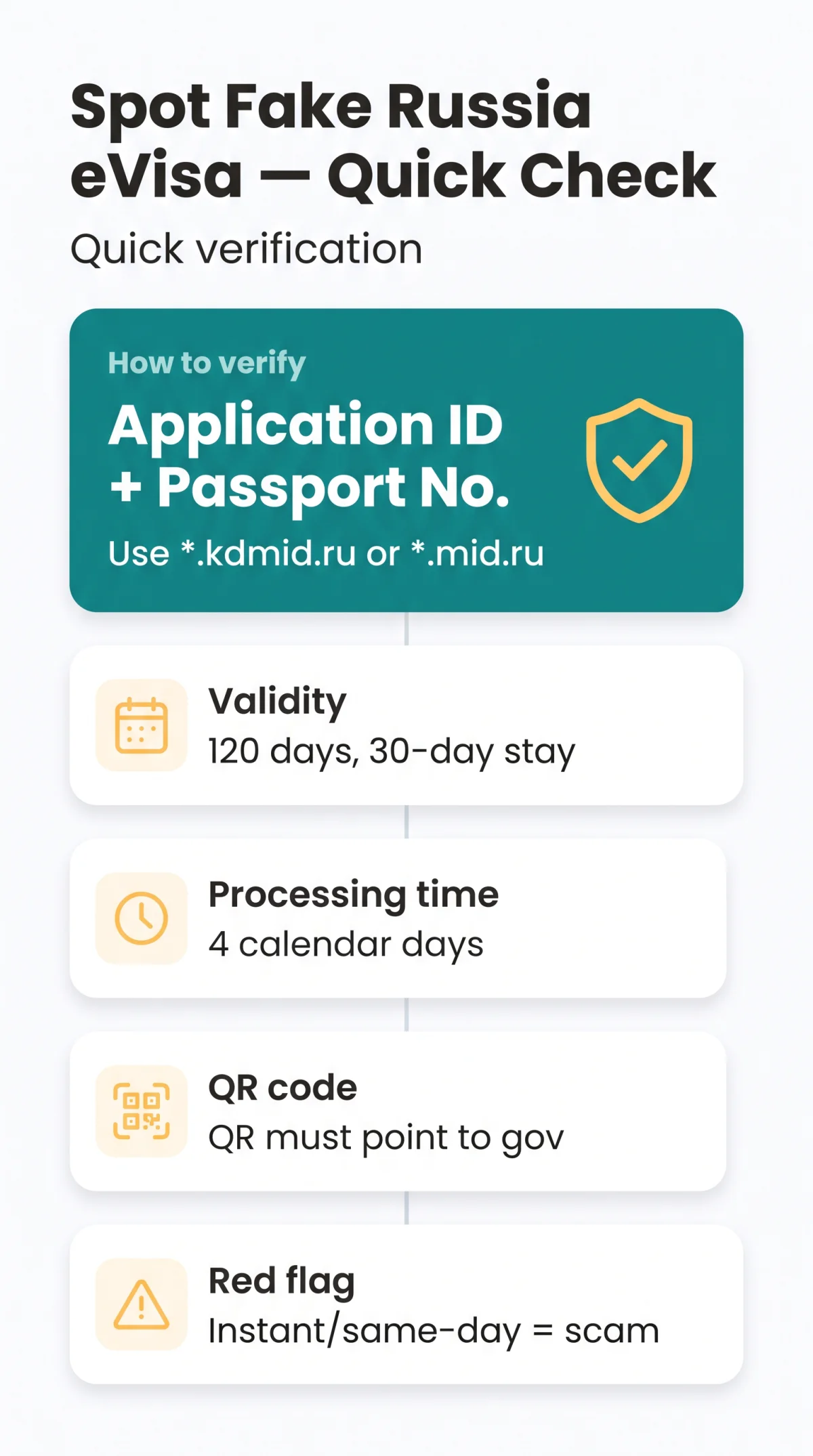
A legitimate Russian eVisa is a digitally signed PDF notification issued via, valid for 120 days with a maximum 30-day stay. The unified e-visa is issued exclusively as a PDF grant notification, not a physical sticker. It permits a single entry with a maximum stay of 30 days and remains valid for 120 days from the date of issue. Standard processing takes 4 calendar days, including weekends and bank holidays. The grant notification can be stored as a printed hard copy or downloaded to a mobile device. Stay is calculated from the day of arrival: the day of arrival and the day of departure count as two days. Any service promising instant or same-day approval is a red flag for a russia e visa fake visa scam. This guide was last verified against the official Consular Department portal on 14 September 2026.
Step-by-Step Guide: Checking Your eVisa Status on the Government Portal
Verify a Russian eVisa at by entering the application ID and passport number. Absence from this database confirms the document is fraudulent.
Access the status checker
Only domains ending in *.kdmid.ru and *.mid.ru are government-operated; unauthorised third-party services are not affiliated with the Russian Consular Department.
Enter your credentials
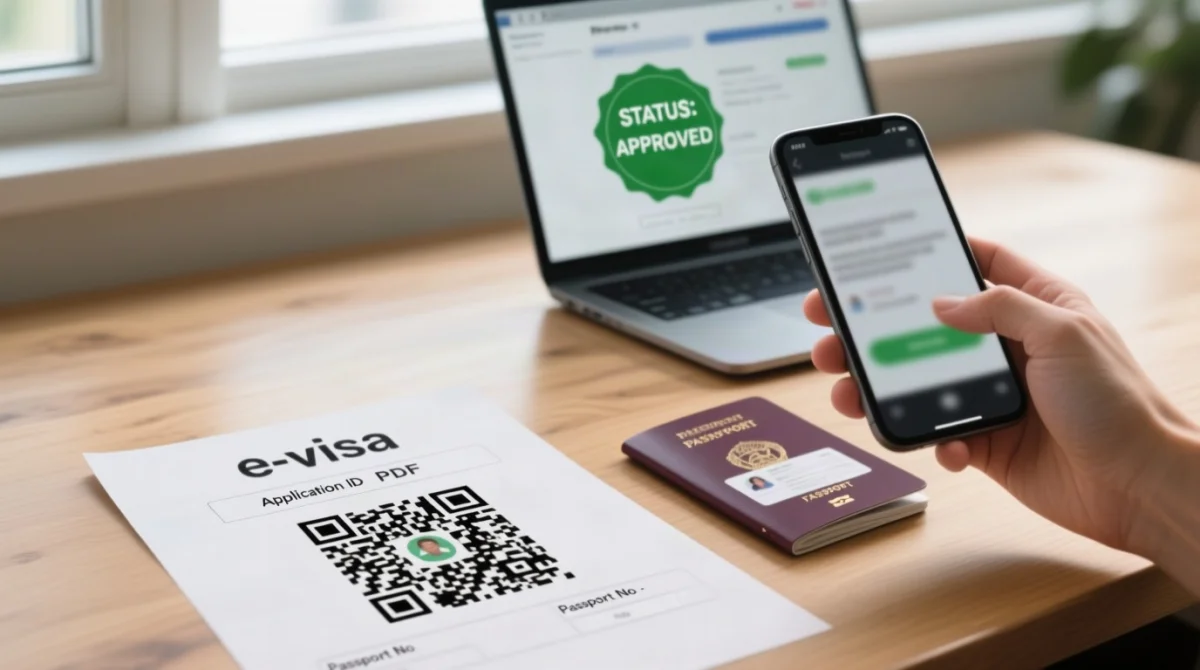
Input your application ID number and passport number. A genuine eVisa returns “Status: APPROVED”; absence confirms fraud.
Check the QR code
Scan the QR code on your eVisa PDF using a reader that previews the URL. It must resolve to the government portal; a dead link indicates a counterfeit.
Verify the PDF digital signature
Open the PDF properties and confirm a digital signature from the consular system is present on the file.
How to Verify Your eVisa Document Is Authentic
Scan the QR code on a Russian eVisa PDF to confirm it resolves to, and verify the file contains a valid digital signature from the consular system.
- QR code validation: Scan with a reader that previews the URL before opening. It must resolve to ; a dead link or redirect elsewhere indicates a counterfeit. Our editorial team tested the verification process: a genuine eVisa QR code resolved to, while a fake eVisa from a Telegram seller produced a dead QR code with no database match.
- PDF digital signature: Open file properties and confirm a digital signature from the consular system is present on the file.
- Visual inspection: Compare layout, fonts, government emblem, and watermark against reference images on the government portal. Physical Russian visas use guilloche patterns, hologram foil elements, and features visible under UV lamp (365 nm), but the unified e-visa PDF relies on digital signatures and QR validation instead.
- Personal data cross-check: All fields must match your passport exactly, including transliteration and MRZ (machine-readable zone) data.
Top Red Flags of Russia e Visa Scams in 2026
- Fake websites & phishing: Sites mimicking the government portal harvest passport data and charge processing fees far above the real consular charge.
- “FMS letterhead” scam: The Russian Federal Migration Service (FMS) was abolished in 2016. Any letter or email bearing its logo is guaranteed fraudulent (Russian Embassy warning, 17 October 2024). Scammers build fake social-media profiles over months, then demand “proof of sufficient funds” or deposits. This is a classic letterhead forgery tactic.
- Unrealistic processing times: Genuine unified e-visa processing takes 4 calendar days. Any “instant” or “same-day” approval is a russia e visa fake visa indicator.
- Social-media sellers: Visa offers via Instagram, Telegram, or Facebook from unverified accounts signal a counterfeit electronic visa and a potential pay-to-play scheme.
Risk: Presenting a fake Russian eVisa at a border checkpoint risks immediate denial of entry, fines, and a multi-year re-entry ban. Incorrect application data can trigger visa revocation at the border or within Russian territory, even for a genuine document. Extension of the unified e-visa is permitted only in force majeure situations, issued as an ordinary non-electronic visa by the Ministry of Internal Affairs.
What to Do If You Encounter a Russia e Visa Fake Visa
Do not attempt to travel
Presenting a fraudulent document leads to immediate denial of entry.
Document everything
Preserve screenshots, email correspondence, payment receipts, and the counterfeit Russian eVisa PDF.
Request a chargeback
Through your UK bank or card provider to dispute the fraudulent transaction.
Report the incident to UK Action Fraud
The national reporting centre for fraud and cybercrime. You can also contact the Russian Embassy in London.
Inform the Russian Embassy
Or nearest consulate so authorities can track the fraudulent operations.
FAQ: Russia eVisa Verification and Scam Prevention
How long does a legitimate Russia e visa take to process?
Processing takes 4 calendar days (incl. weekends); submission window is 86 to 4 days before entry. Instant approvals are scams.
What should I do if my e visa verification shows no result?
Absence from means fraud. Do not travel; document evidence and contact the Russian Embassy or nearest consulate for consular verification.
Can I trust third-party websites to apply for my e visa?
No. Third-party sites (e.g. ) are private, charge USD 40, and are not official. Apply at or via the Russian Foreign Ministry mobile application.
How do I get a refund if I paid for a fake Russia e visa?
Follow the chargeback and Action Fraud steps detailed in the section above. The official consular fee is non-refundable, but scam payments can often be disputed within the chargeback window.
Is there a fee to check my e visa status on the government portal?
No. Status check is free on. Never pay for verification.
What is the Federal Migration Service scam letter?
The Russian FMS was abolished in 2016. Russian Embassy (17 Oct 2024) warns scammers use fake FMS letterhead to demand deposits after months of social-media contact.
Can a fake e visa get me banned from Russia?
Yes. Presenting a fake eVisa risks denial of entry, fines, and a multi-year re-entry ban.
Are QR codes on Russia e visa documents always scannable?
QR code must resolve to; use a URL-preview scanner. Fake eVisas may have dead or malicious codes.
This guide is independent editorial content. We have no affiliation with the Russian Consular Department or any third-party visa agency, and we do not accept payment for placement or recommendations. Last reviewed: September 2026.